
Contaminated medical vacuum pipeline — why blowing through, steam and spirit do not work
A medical vacuum pipeline system draws blood, secretions and tissue fragments out of the patient. As long as it keeps pulling, nobody looks inside it. The trouble starts on the day contamination stops being a matter of a single terminal unit — and it turns out that the pipeline cannot simply be flushed through.
Where the contamination comes from and why it reaches further than it appears
An overfilled suction jar, a damaged antibacterial filter or suction carried out without a separator is enough for biological material to pass the terminal unit and enter the pipeline. From that moment on it does not stop where it entered — the negative pressure draws it further, towards the source, through successive branches of the network.
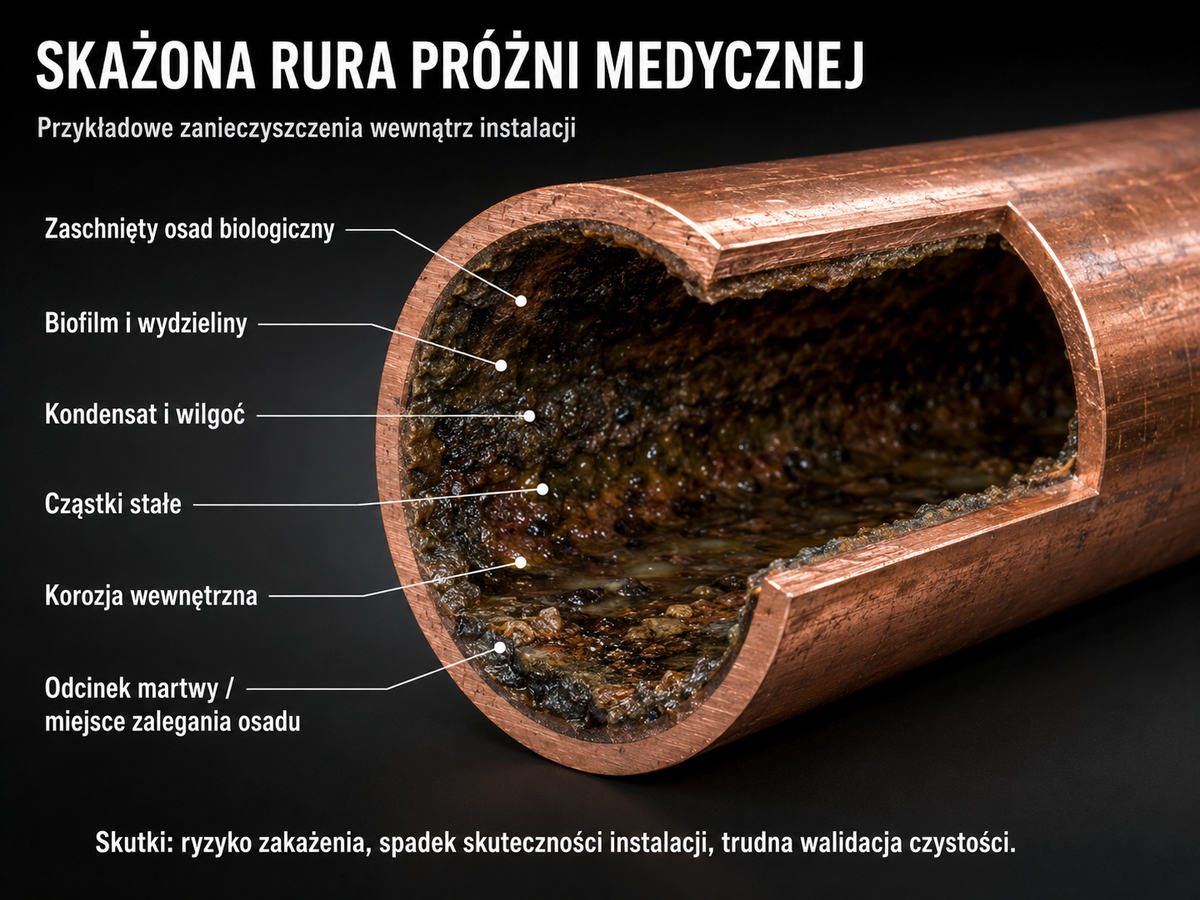
Inside there is nothing to stop it. The copper pipeline is dry, dark and practically never flushed, so dried deposits and biofilm remain there for years. They are not visible from the outside, and neither a leak test nor a vacuum measurement will detect them. The system looks fully operational the whole time, because from a technical point of view it is operational.
The most difficult places are the ones nobody thinks about: elbows, tees and dead legs — that is, short branches left behind after refurbishments, capped off and unused. That is where deposits cling most firmly, and it is these points that determine whether decontamination makes any sense at all.
This is not a technical installation, it is a class IIa medical device
A medical vacuum installation is not a technical installation. It forms part of a medical gas and vacuum pipeline system (SRGM) and is a class IIa medical device subject to Regulation (EU) 2017/745 (MDR).
The consequence is a very practical one: any intervention in the pipeline constitutes a modification of a medical device. This is not work that can be contracted out to “someone who does pipework” and accepted on trust. It requires a quality management system, a documented risk assessment and, at the end, repeat testing and commissioning of the system together with formal confirmation that the device has been returned to conformity.
In other words: cleaning a contaminated vacuum system does not end at the moment dirt stops coming out of the pipe. It ends at the moment there is a document that confirms this in a verifiable way.
Three methods reached for instinctively — and why none of them works
Each of the ideas below comes up in discussions about contaminated vacuum systems. Each has the same flaw: it works locally at best, over a short, straight run of a few metres, and does nothing in elbows, tees or dead legs. None of them can be validated either, that is, proved to have worked.
- Blowing through with carbon dioxide or nitrogen. A gas is not a biocide — it displaces the contamination, it does not kill it. Cooling with carbon dioxide actually preserves micro-organisms instead of destroying them. On top of that comes the risk of blocking the system with dry ice and the danger of asphyxiation in enclosed rooms.
- High-temperature steam. The thermal expansion of copper overloads brazed joints and pipeline supports, while condensate floods a system that is meant to stay dry. In a branched network it is impossible in any case to achieve sterilising conditions over the entire length.
- Pouring in spirit. Ethanol loses its effectiveness on contact with protein, which it additionally fixes — so it can make the situation worse. It is also ineffective against spores. Safety is a separate matter: ethanol vapours in vacuum pumps mean a real risk of fire or explosion, against which Annex H to PN-EN ISO 7396-1 warns explicitly.
The common denominator is that all three give the feeling that “something has been done”, and none of them answers the question of whether the system is clean.
The order that cannot be reversed: cleaning first, disinfection afterwards
This is the rule people most often come unstuck on. Every disinfectant is neutralised by organic matter and does not penetrate dried deposits or biofilm. If blood, protein and fat remain in the pipe, the agent is consumed on the surface of that deposit and does not reach the micro-organisms underneath.
That is why the biological load must first be physically removed and only then disinfected. Omitting the cleaning stage makes the disinfection illusory — and, worse still, impossible to validate. The test result may come out good while the contamination remains under the deposit.
How you know it worked — validation instead of declarations
With a class IIa device, “we cleaned it” is not a result. The result is confirmation that there are no longer any viable micro-organisms at the worst possible points of the system. Two elements cannot be omitted here.
Siting of control points at worst-case locations. Not at the point with the easiest access, but at the most distant ends, in dead legs, elbows and tees. A control point sited in a convenient spot can give a good result on a system that is still contaminated.
Confirmation by an accredited laboratory. Samples from the system are tested by a laboratory accredited by the Polish Centre for Accreditation (PCA). The acceptance criteria are set before the testing, not after the results have been seen. A report from such a laboratory is the only document that will stand up to an inspection and to an insurer.
Finally, the system undergoes repeat testing and commissioning to PN-EN ISO 7396-1:2016-07 — leak tightness, cleanliness, flow parameters and identification, just as for the commissioning of a new network.
What must be replaced without exception rather than disinfected
Hoses and flexible lines in pendants and supply units that have been in contact with the contamination are replaced with new ones. There is no disinfection option here.
The reason lies in the material: rubber and elastomers absorb tissue material deep into the wall. It cannot be removed from there and, equally importantly, it cannot be proved that it has been removed. A hose left in place becomes a permanent reservoir of contamination which, after a few days, will re-seed the cleaned system all over again. The remaining elastomer components on the contaminated side are treated in the same way.
This is a good litmus test for a quotation. If a contractor proposes disinfecting the hoses instead of replacing them, they either do not understand the problem or are counting on nobody checking.
Does the hospital lose its vacuum supply for months?
No — and this is the most common fear, because of which the subject is sometimes put off for years. The work is carried out zone by zone, using the existing zone valves as boundaries. At any given moment one zone is shut down, while the vacuum source and the remaining part of the building operate normally.
The shutdown time for a single zone is measured in hours, at most a few days. The sequence is set from the less critical zones to the critical ones, and for areas such as intensive care units (ICU) or operating theatres continuity cover is provided — bedside suction units or a temporary independent vacuum source.
What the hospital receives at the end
From the point of view of the supervisory authority, decontamination without documentation is an event that never took place. The complete set handed over on completion of the work comprises:
- reports from the cleaning stage together with a mass balance — confirmation that nothing has been left in the system;
- process records from the disinfection stage and a report releasing the zone back into use;
- a validation report confirming effectiveness at the worst-case points;
- a microbiological test report from a laboratory accredited by PCA;
- reports of the repeat testing and commissioning to PN-EN ISO 7396-1:2016-07;
- a contaminated waste transfer note — for filters, separators and the replaced hoses;
- an update of the operating documentation and confirmation that the conformity of the class IIa device has been restored.
Frequently asked questions
Does a contaminated pipeline have to be replaced with a new one?
Not in every case. A copper system already built into the fabric can be decontaminated in situ, without breaking open walls and replacing pipework — provided that the process is carried out in the correct order and completed with validation. Replacing the pipeline only becomes necessary when the contamination cannot be reliably removed and confirmed.
Is it enough to replace the antibacterial filters?
No. Replacing the filters and separators is a preliminary step, not a solution — it removes the source of further contamination, but does not touch what is already in the pipeline.
Does the vacuum receiver also require intervention?
It depends on how far the contamination has spread. When the work is properly conducted, the receiver remains isolated and protected. If, however, biological material has reached it, or its cleanliness cannot be reliably confirmed in situ, the receiver may have to be taken out of service temporarily — with supply ensured from a reserve source.
Who may carry out such work?
An organisation operating under a quality management system for medical devices, conducting risk assessment and able to carry out repeat testing and commissioning of the system. The ability to braze copper alone is not enough — what decides the matter is the formal side and the ability to prove the result.
How can you tell that a quotation is serious?
By three things: whether it provides for a cleaning stage before disinfection, whether it ends with validation and testing by an accredited laboratory, and whether it assumes replacement of the hoses instead of their disinfection. The absence of any one of these points means that the result cannot be defended.
Basis
- PN-EN ISO 7396-1:2016-07 — clauses 11 and 12 (testing, commissioning, marking), Annex H (hazards during work on vacuum systems)
- MDR — Regulation (EU) 2017/745 — classification of medical devices
- ISO 13485 — quality management system for medical devices
- ISO 14971 — risk management for a medical device
- ISO 14937 — validation and routine control of the decontamination process
Medpipe has developed and implemented a system procedure for the decontamination of a medical vacuum pipeline system (MP-SOP-VAC-DECON-01), conducted within the ISO 13485 quality management system, with risk assessment to ISO 14971, microbiological validation and repeat testing and commissioning to PN-EN ISO 7396-1:2016-07. The technological details constitute company know-how and are not published; the scope, the zone schedule and the acceptance criteria are agreed individually for the system in question. To have a specific case assessed — contact us.
A broader treatment of the operation, acceptance and documentation of medical gas installations is provided in the guide „Medical gases in practice. Volume 1" (GMWP) developed by INMED S.A. — order the GMWP guide.