

Who will hear the alarm at three in the morning
2026-06-02 · Małgorzata Dopierała, Damian Czyczyro, Przemysław Kostera
In brief. Standard PN-EN ISO 7396-1:2016-07 distinguishes clinical alarms (danger to the patient — immediate reaction of medical staff) and operational alarms (a technical event — reaction of the technical services). The signals must reach a place where someone hears them around the clock. The emergency procedure must also work when the technical department is asleep — it is part of the Operational Management Documentation.
The same buzzer signals a clogged filter and a drop in oxygen pressure in intensive care. The difference lies in who has to get up and what they have to do.
A medical gas alarm rarely sounds like a disaster
It sounds like a buzzer in the corridor that someone mutes and walks on. That is precisely the problem: apparent routine hides the real stake. The same signal may mean a service event to be handled on Monday, or an event in which the time taken to reach the shut-off valve is what counts.
Medical gas alarms are therefore classified not by loudness, but by who is to respond to them and within what time.
Clinical and operating alarms — how do they actually differ?
| Alarm type | What it signals | Who reacts |
|---|---|---|
| clinical | danger to the patient, e.g. a drop in oxygen pressure on a ward | medical staff — immediately |
| operational | a technical event, e.g. a dirty filter, a compressor failure | technical services — within an agreed time |
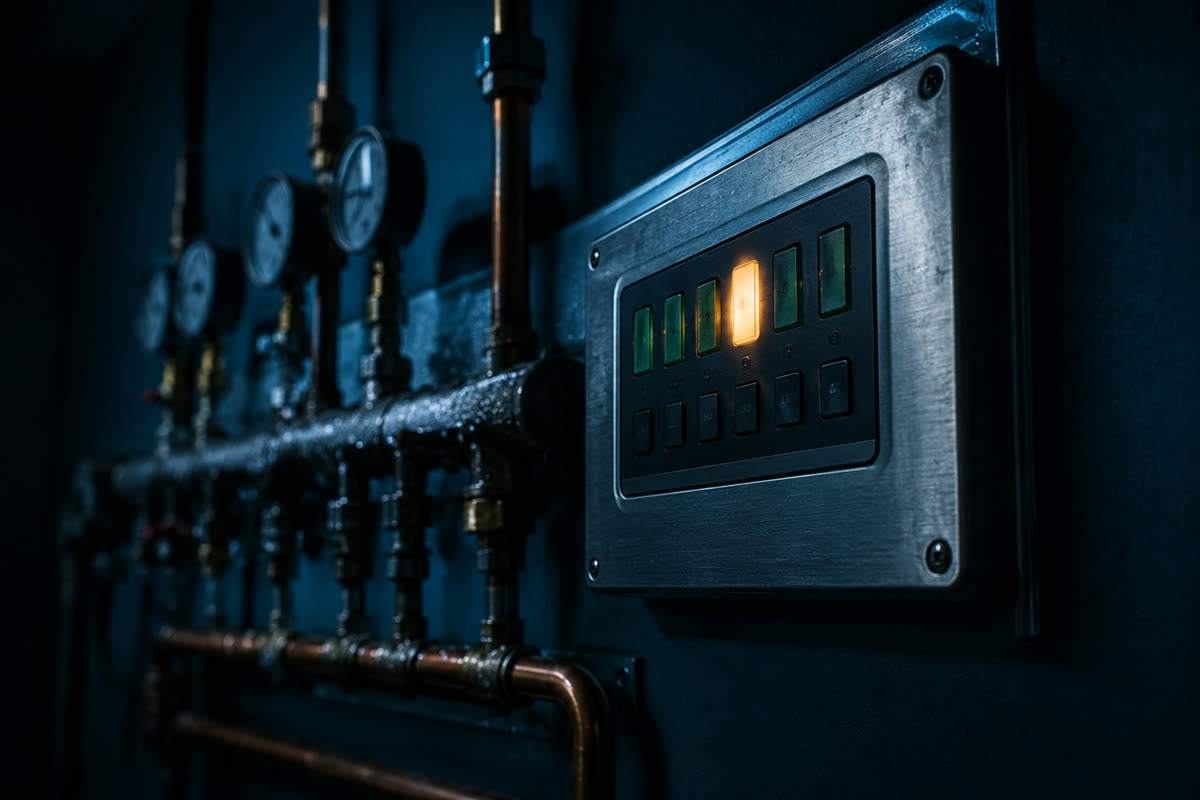
A clinical alarm reports what is happening at the patient; an operating alarm reports what is happening at the supply source. The first concerns the gas parameters where it is delivered — and its addressee is the ward staff, because they have the patient within arm's reach.
The second concerns the condition of the installation, the compressors, the cylinders and the reserves — and it is addressed to the technical service. This distinction is described in the guide „Gazy medyczne w praktyce. Zeszyt 1” (GMWP) developed by INMED S.A.
Which signal should reach whom?
To the person who actually has the ability to act — not to whoever happens to be closest to the panel. A signal that reaches only an empty plant room formally works and practically does not exist.
Before the notification paths are mapped out, it is worth answering a few questions:
- Who physically hears and sees the signal at a given time of day?
- What powers does this person have — may they shut off a zone, or only pass the call further on?
- Is SSGM signalling system is it only local, or does it collect data at a single point?
- Who takes over responsibility when the first person does not answer?
Central gas monitoring solves some of these questions because it shows the state of the whole installation in one place. It solves none of them if there is nobody at the screen.
The hospital's emergency procedure must work while the technical department is asleep
A procedure is worth as much as its weakest shift — the night shift, the weekend shift and the holiday shift. The test is simple: does the nurse on duty know what to do in the first three minutes, before anyone picks up the phone.
A well-built response path does not start with the service hotline number, but with an unambiguous decision: what we do with the patient and what with the installation, and in what order. The principles underlying this — including the allocation of responsibilities and the requirements for alarm signalling — are discussed by GMWP.
Frequently asked questions
Does muting an alarm close the event?
No. Muting removes the sound, not the cause. The event ends only once the source has been identified and the response documented.
Does central monitoring replace local panels?
It does not replace it. Local panels inform those who are at the patient's side, central monitoring informs those who manage the installation. These are two layers of the same information.
How often should the notification path be tested?
Regularly, and always outside administrative office hours. A test on Wednesday at eleven says nothing about Sunday at three.
Basis
- PN-EN ISO 7396-1:2016-07 — the split into clinical and operating alarms, requirements for signalling
- Medical Gases in Practice, Booklet 1, 2026 ed., INMED S.A. — who each signal is addressed to, division of responsibility, the emergency procedure within the Operational Management Documentation
The full distinction between alarm types, the principles for designing signalling and a template for building a response procedure can be found in the guide — order the GMWP guide.
See also: audits of medical gas installations, contaminated medical vacuum pipeline.
Prepared by: the technical team of Małgorzata Dopierała, Damian Czyczyro and Przemysław Kostera — Medpipe Sp. z o.o., design, audits and inspections of medical gas installations. This article is based on the guide „Gazy medyczne w praktyce. Zeszyt 1” (Medical Gases in Practice, GMWP), INMED S.A.