

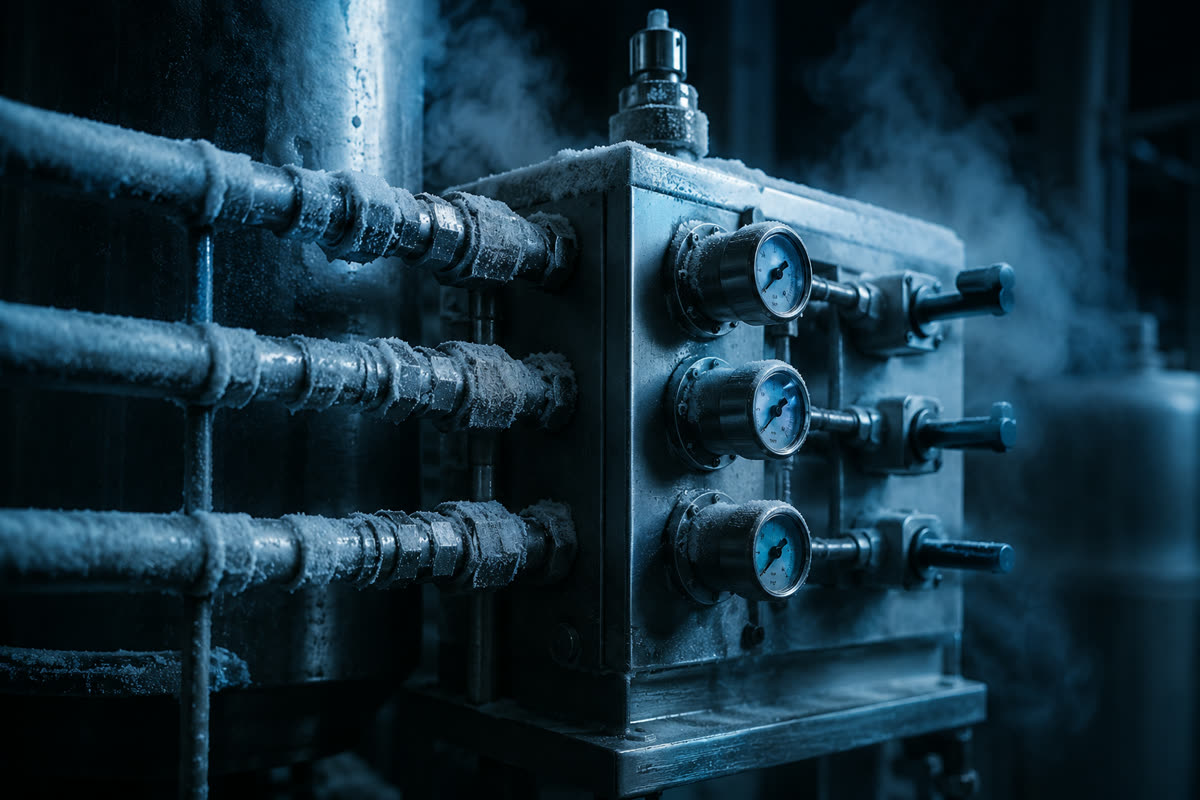
A full oxygen tank is not yet continuity of supply
2026-06-15 · Małgorzata Dopierała, Damian Czyczyro, Przemysław Kostera
In brief. Continuity of supply requires three sources: primary, secondary and reserve — with automatic changeover, because in a failure nobody will manage to react manually. A full tank describes the gas stock, not the capacity available at the terminal unit at the moment of failure. The requirements for the supply system are set by the standard PN-EN ISO 7396-1:2016-07.
A full tank tells you how much gas the hospital has in reserve. It says nothing about how much it will manage to deliver in the second when one component of the installation fails.
Why is a full tank not yet continuity of supply?
Gas stock and actually available capacity are two different quantities. A cryogenic oxygen tank describes the volume the hospital has at its disposal; continuity of supply describes the flow and pressure available at the terminal unit at the worst possible moment.
You can have a full tank and still too little oxygen where it is needed. The bottleneck may be the vaporiser, the pressure regulator, the pipeline cross-section or the simultaneity of demand across the wards — not the liquid level. Volume is the stock. Capacity is the ability to deliver it.
The three-source principle: primary, secondary, reserve
| Source | Role | Example |
|---|---|---|
| primary | covers the entire demand in continuous operation | cryogenic oxygen tank, compressor plant |
| secondary | takes over the supply automatically when the primary source fails | an equivalent supply system |
| reserve | maintains the supply for the duration of the repair | emergency cylinder banks |
Medical gas supply sources are designed as three independent layers, not as a single device with a margin. The primary supply source runs day to day, the secondary takes over when the primary is exhausted or shut down, and the reserve is the last line — for failures and for service periods.
The point of this arrangement is not to multiply equipment. The point is that no single event — a failure, an inspection, a delayed tanker — must not cut off the installation. The same logic applies where the source is not a delivery but a machine: in the medical compressed air compressor room and in a system with a medical vacuum pump unit.
Automatic changeover matters because no one will manage to react in time
Switching over to the next supply source must happen without human involvement. A pressure drop in the pipeline does not wait for a phone call to the technician or for someone to reach the plant — and the consequences are borne by a ventilator, not by a table in the documentation.
Equally important is what happens po switchover: the information that the installation has fallen back to the reserve supply source must arrive while there is still time to react. A silent switch to reserve is a failure deferred, not resolved.
What determines resilience to failure and to delivery delay?
Resilience is the ability to survive a failure and a delayed delivery at the same time. In practice it is decided by a few things that are not visible on the pressure gauge:
- the actual capacity at peak demand, not the nominal capacity;
- actual independence of the supply sources — electrical supply, location, pipeline routing;
- autonomy time counted in hours at the assumed consumption, not in a “full tank”;
- the behaviour of the system after the loss of one machine in the compressor room or one vacuum pump;
- signalling and alarms that turn a technical event into an organisational decision.
The selection criteria, requirements and the method of calculating these quantities are described in the guide „Gazy medyczne w praktyce. Zeszyt 1” (GMWP) developed by INMED S.A.
Frequently asked questions
Can a cryogenic oxygen tank be the only supply source?
No — a single source means a single point of failure. The tank usually acts as the primary supply source, but it must be supplemented by a secondary and a reserve supply source of defined capacity and autonomy.
Does a medical air compressor room also require redundancy?
Yes, and particularly so. Medical compressed air and medical vacuum are generated on site, so a machine failure translates immediately into the supply — the system must maintain its parameters after the loss of the single largest unit.
What if the gas delivery is delayed?
That is when the part of the installation designed for the „the delivery will not arrive” scenario goes to work. The rules for sizing autonomy and the switching sequence are compiled in GMWP.
Basis
- PN-EN ISO 7396-1:2016-07 — requirements for the supply system: primary, secondary and reserve source, automatic changeover
- Medical Gases in Practice, Booklet 1, 2026 ed., INMED S.A. — criteria for selecting sources, calculating autonomy and capacity at peak demand
If you are planning a modernisation or verifying an existing arrangement of supply sources, order the GMWP guide and check your installation against the criteria described in it.
See also: medical gas installations for hospitals, medical gas installation projects in hospitals.
Prepared by: the technical team of Małgorzata Dopierała, Damian Czyczyro and Przemysław Kostera — Medpipe Sp. z o.o., design, audits and inspections of medical gas installations. This article is based on the guide „Gazy medyczne w praktyce. Zeszyt 1” (Medical Gases in Practice, GMWP), INMED S.A.