
What you can no longer check once the ceiling is closed
2026-06-23 · Małgorzata Dopierała, Damian Czyczyro, Przemysław Kostera
In brief. Before the ceiling is closed, you check what no visual inspection will later verify: pipeline routes and supports, the quality of the brazed joints, the marking of sections. Brazing of medical gas pipelines requires certified brazer qualifications. Acceptance tests according to the standard PN-EN ISO 7396-1:2016-07 must precede the enclosure — after the ceiling is closed, verification means dismantling.
A suspended ceiling is closed up in a single day. What has been left behind it will work for twenty years, and for twenty years nobody will see it.
Why is the moment the installation is concealed a point of no return?
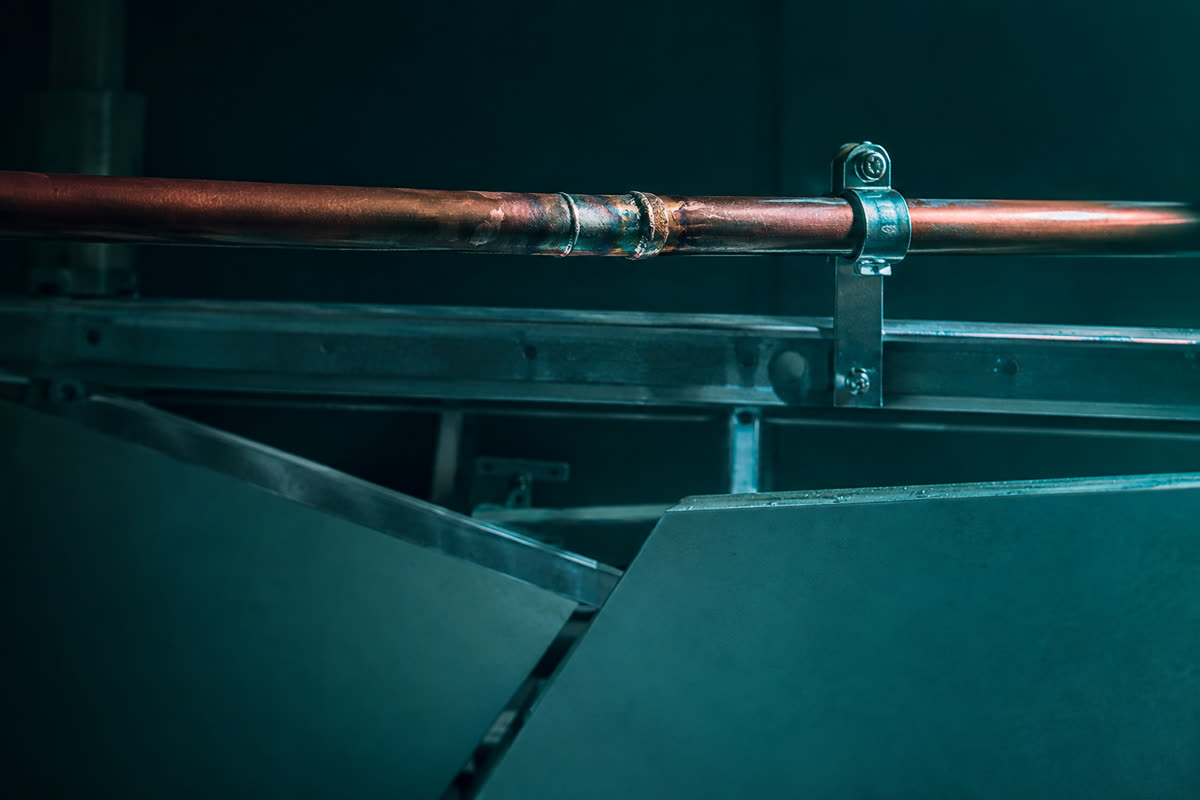
Once the ceiling is closed, verifying the pipeline is no longer a matter of visual inspection but a matter of dismantling. Copper medical gas pipelines look unremarkable at handover: a few metres of pipe, a few brazed joints, a few brackets. That apparent routine is precisely what is at stake, because an error hidden behind a panel reveals itself only as a pressure drop in the operating theatre.
What can only be checked before concealment?
Before concealment, everything relating to the physical execution of the installation is checked; afterwards only documents and measurements at the terminal units remain. Inspection before concealment is the last moment at which the installation is still evidence in itself.
- qualification of the personnel and procedures making the brazed joints,
- the route of the pipelines, distances from other installations, passages through building partitions,
- the spacing and type of supports and freedom for thermal expansion,
- internal cleanliness of the pipes and capping of the ends during installation,
- tests that must be performed while the section is still exposed.
The list is not exhaustive — the full scope of what must be confirmed before concealment is set out by the GMWP.
Brazing: qualifications are part of the product, not a formality
Brazing qualifications treats it as an element of proof of correctness, not as paper for a binder. The correctness of joining under an inert gas shield is assessed through a qualified procedure and an authorised installer, not by the external appearance of the joint. If the record was not produced during installation, it will never be produced once the work is covered up, because there is nothing left to assess. Detailed requirements and the scope of documentation are set out in the guide „Medical gases in practice. Volume 1" (GMWP) developed by INMED S.A.
Labelling and acceptance testing must precede the ceiling panel
Pipeline labelling and acceptance testing of the installation have one thing in common: they concern sections that will later be inaccessible. A label on an exposed pipe makes it possible, years later, to identify the gas without taking down the ceiling. A leak test on an open section pinpoints the location of the leak; the same test after the section has been covered up only tells you that there is a problem somewhere.
GMWP describes which tests and acceptances are to be carried out in this sequence and what should be included in the as-built documentation.
Frequently asked questions
Can the inspection before concealment be made up later?
No. It can only be repeated by exposing the installation, which means cost and downtime of the ward. Concealing it does not remove the obligation, it only raises its price.
Who should take part in such an inspection?
The installation contractor, the site inspector and a representative of the hospital's future technical user. The third party matters here, because it is the one that will maintain this installation.
Why label a pipeline that will be concealed anyway?
Because concealed does not mean inaccessible for ever. During any later intervention, the marking decides whether the crew knows which pipe it is holding.
Basis
- PN-EN ISO 7396-1:2016-07 — acceptance testing and pipeline marking before concealment
- Medical Gases in Practice, Booklet 1, 2026 ed., INMED S.A. — scope of the inspection before concealment, qualification of brazers and of the brazing procedure
The full requirements, the sequence of acceptances and the scope of documentation are described in Zeszyt 1. If you are planning the installation or acceptance of a medical gas installation, order the GMWP guide and keep the list at hand before the crew starts putting up the panels.
See also: medical gas installation projects in hospitals, audits of medical gas installations.
Prepared by: the technical team of Małgorzata Dopierała, Damian Czyczyro and Przemysław Kostera — Medpipe Sp. z o.o., design, audits and inspections of medical gas installations. This article is based on the guide „Gazy medyczne w praktyce. Zeszyt 1” (Medical Gases in Practice, GMWP), INMED S.A.