

In a hospital, oxygen is a medicinal product, not a technical utility
2026-07-04 · Małgorzata Dopierała, Damian Czyczyro, Przemysław Kostera
In brief. Medical oxygen is a registered medicinal product — it has a name, composition, indications and an expiry date; the pipeline is only the route of administration. Responsibility for the quality of the gas at the patient lies with the hospital pharmacy and the person responsible for quality, not the technical department. The installation remains a medical device within the meaning of Regulation MDR (EU) 2017/745, and the technical requirements are set by the standard PN-EN ISO 7396-1:2016-07.
Compressed oxygen administered to a patient is a registered medicinal product, not a technical utility like chilled water or workshop compressed air. That single difference shifts responsibility from the workshop to the hospital pharmacy.
In a hospital, oxygen simply flows through a pipe. That is all one can see. The rest — registration, batch number, expiry date, approval for use — is invisible and for that very reason is often omitted from the division of responsibilities.
Why is medical oxygen a medicinal product and not a technical utility?
Medical oxygen is a registered medicinal product: it has a name, composition, indications, dosage and expiry date, exactly like a tablet. The pipeline is merely the route of administration.
The consequence is inconvenient for the established division of roles. Since a medical gas is a medicinal product, the hospital does not “operate an installation”, it stores and dispenses a medicinal product. And a medicinal product is not supervised according to the logic of plant maintenance.
What can the technical department not take on?
The technical department is responsible for the installation — performance, pressure, tightness, continuity of supply — but not for the status of the medicinal product. The boundary runs where the handling of the medicine begins.
Outside technical competence there remain, among others:
- pharmaceutical supervision of the receipt, storage and dispensing of the gas;
- qualification of suppliers and verification of batch quality documentation;
- the decision to release the gas for use on a patient;
- handling of complaints, suspension and recall of a batch;
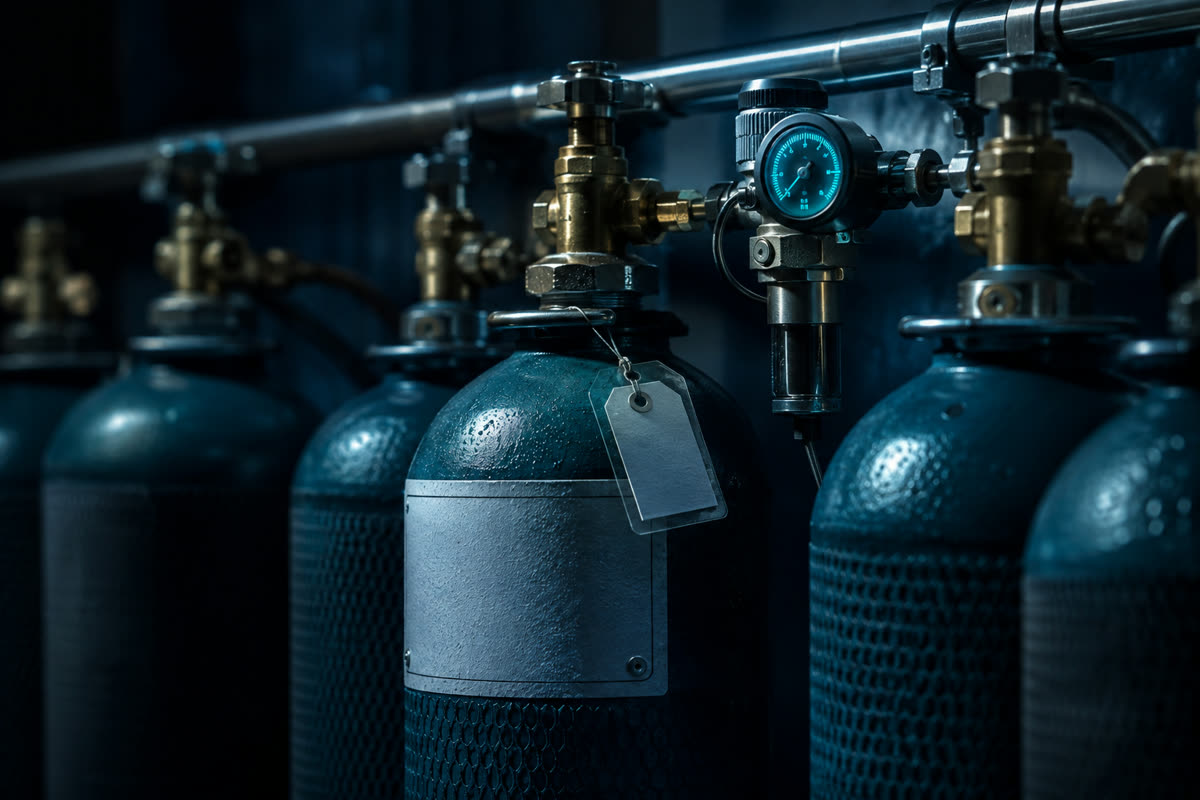
- treating the cylinder as a medicinal product container, not merely a pressure vessel.
What does the role of the hospital pharmacy and of the person responsible for quality consist of?
The role of the hospital pharmacy is that it — and not the workshop — keeps the records, supervises distribution and is accountable for the patient receiving a product of confirmed quality. The person responsible for quality is the last decision-making link: they sign a release, not an opinion.
A special case is medical air quality produced on site, in the hospital's compressor plant room. The hospital then ceases to be merely a recipient and becomes the party responsible for the product manufactured. The delimitation of these roles is described in the guide „Medical gases in practice. Volume 1" (GMWP) developed by INMED S.A.
When may the gas be released for use on a patient?
Only once the test result confirms conformity with the quality requirements and an authorised person issues a written release. Technical acceptance and the leak test are a necessary condition, never a sufficient one.
This is where the gap most often arises. Gas quality control (QC) is sometimes treated as a formality closing the construction works rather than as the gate through which the medicinal product reaches the patient — and through which passes every time, also after every intervention in the installation. The GMWP guide shows how to embed this gate in the hospital's procedures.
Frequently asked questions
Is medical air from a compressor also a medicinal product?
Yes — the intended purpose decides, not the method of production. Air delivered to a patient is subject to quality requirements regardless of whether it arrived in a cylinder or was produced in a compressor room in the basement.
Is a cylinder packaging or pressure equipment?
Both, but the order matters. As the packaging of a medicinal product, the cylinder carries the batch identification and the expiry date; its pressure-equipment dimension concerns handling safety, not the product's status.
Who signs the release of the gas for use?
A person designated in the hospital as responsible for quality, acting in agreement with the pharmacy. This is not a technical role and it cannot be transferred to the installation contractor.
Basis
- Regulation (EU) 2017/745 (MDR) — the medical gas installation as a medical device
- PN-EN ISO 7396-1:2016-07 — technical requirements for the pipeline system
- Medical Gases in Practice, Booklet 1, 2026 ed., INMED S.A. — the boundary of responsibility between the technical department, the hospital pharmacy and the person responsible for quality
The full division of responsibilities, the documentation requirements and practical procedural templates can be found in the guide — order the GMWP guide.
See also: audits of medical gas installations, contaminated medical vacuum pipeline.
Prepared by: the technical team of Małgorzata Dopierała, Damian Czyczyro and Przemysław Kostera — Medpipe Sp. z o.o., design, audits and inspections of medical gas installations. This article is based on the guide „Gazy medyczne w praktyce. Zeszyt 1” (Medical Gases in Practice, GMWP), INMED S.A.