

Inventory of medical gas installations — where to start when the documentation does not exist
2026-08-24 · Małgorzata Dopierała, Damian Czyczyro, Przemysław Kostera
In brief. An inventory of a medical gas installation without surviving documentation starts with establishing the system boundaries and identifying the supply sources, not with measurements. The legal basis of the documentation obligation is the Act of 7 April 2022 on medical devices. The scope of the required records is set by the standard PN-EN ISO 7396-1:2016-07, including the register of operational activities. The result of the inventory is a diagram of the installation with the location of the zone valves and the assignment of terminal units to zones. Without this assignment, a zone cannot be safely shut off in an emergency.
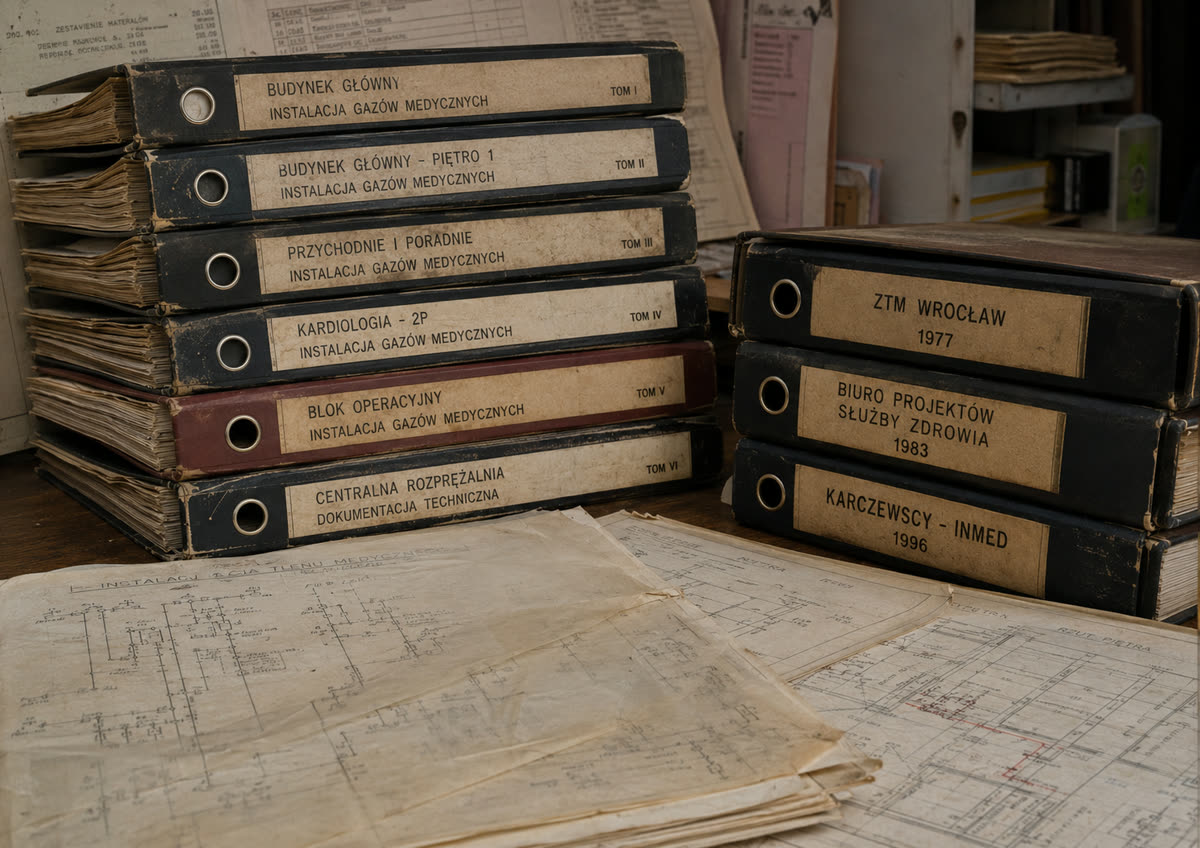
In many Polish hospitals the medical gas installation is older than the oldest employee of the technical department. It was extended with every ward refurbishment, every contractor left behind a different standard, and the documentation of successive reconstructions disappeared along with the archives. The result: the installation works, but nobody knows exactly where it runs, where the zone valves are and what actually supplies which bed.
As long as everything works, this state seems harmless. It stops being harmless in three situations: during a failure, when the right zone must be shut off quickly; during a refurbishment, when the designer asks about the existing state; and during an inspection, when you must present a register of activities that has nothing to rest on.
Where to start an inventory when there is no documentation
- Establishing the system boundaries and identifying the supply sources: compressor plants, vacuum plants, cylinder manifold rooms, emergency cylinder banks.
- Analysis of the surviving documentation — even fragmentary; it helps date the reconstructions and shortens the work.
- A walk-through of the installation from the sources to the terminal units, ward by ward, with photographic documentation.
- Identification of routes in hidden spaces and tests assigning valves to zones — in agreed service windows.
- Preparation of diagrams, schedules and a list of discrepancies between the actual state and the labels.
The order is not accidental: without knowing the sources and the system boundaries, valve tests cannot be safely planned and measurements cannot be interpreted.
Which documents are required by law?
The Act of 7 April 2022 on medical devices imposes obligations on the user that cannot be fulfilled without documentation. Art. 63(1) requires the device to be properly installed and maintained, paragraphs 3 and 4 order documentation to be kept of completed installations, repairs, maintenance, inspections and safety checks together with the dates of the next activities, and paragraph 5 requires it to be retained for at least 5 years after the device is no longer used.
There is also a supervisory power: Art. 64(1)(5) gives the President of the URPL the right to inspect entities performing activities on devices — at the place where they are performed. The lack of a register and diagrams is therefore not a housekeeping lapse but a non-compliance with the Act, which can be established regardless of whether the installation happens to be working correctly.
There is also a purely practical layer: the operational management documentation described by PN-EN ISO 7396-1 assumes that you know what you are managing. You cannot appoint people responsible for zones, draw up an inspection schedule or prepare emergency procedures for pipelines whose routes nobody knows.
What exactly an inventory reconstructs
An inventory of a medical gas installation is the reconstruction of the actual state in a form fit for further work. In practice it covers six layers:
- pipeline routes — the runs through the building together with diameters, including sections hidden above suspended ceilings and in shafts;
- terminal units — location, type of gas, socket type, technical condition, assignment to zones;
- zone valves and area valve service units — where they are, what they shut off, and whether they shut off what the label suggests;
- supply sources — compressor plants, vacuum plants, cylinder manifold rooms, emergency cylinder banks, together with their formal status;
- monitoring and alarm systems — sensors, panels, signalling coverage;
- marking — the conformity of pipeline and valve labels with the actual state, a list of gaps.
The result is a set of diagrams, schedules and a list of discrepancies — documents that become the basis of the register under Art. 63 and of the operational management documentation.
A trap few people think about: labels that do not match reality
The most dangerous finding of an inventory is not missing documentation, but documentation and marking that lie. A valve labelled as shutting off ward A that also shuts off half of ward B. A pipeline labelled as oxygen running where, after three reconstructions, nobody expects it. In everyday work this is invisible. In an emergency — when someone under time pressure closes a valve according to its label — the difference can be dramatic.
That is why a reliable inventory does not copy old diagrams but verifies every element in the field. This distinction is worth checking in an offer: reconstructing documentation “from behind a desk”, based on archive designs, perpetuates errors instead of revealing them.
Inventory versus audit — the order matters
The two services are often confused, yet the difference is simple. An inventory answers the question: what do we have? An audit answers the question: is what we have compliant with the standard and the regulations — and what should we do about it?
The order cannot be reversed. A compliance audit to PN-EN ISO 7396-1 requires knowledge of what is being assessed: without inventoried routes, terminal units and sources, the assessment will cover only what is visible — usually the least problematic part of the installation. In facilities without documentation, the inventory is therefore the first stage of the audit — not a separate commission that can be skipped.
How it proceeds in a working hospital
An inventory does not interfere with the operation of the installation — it consists of visual and measurement activities carried out without interrupting the supply to wards. A typical course looks like this:
- analysis of what has survived — even fragmentary documentation shortens the work and helps date the reconstructions;
- a walk-through of the installation from the sources to the terminal units, ward by ward, with photographic documentation;
- identification of routes in hidden spaces — above ceilings, in shafts, in ducts;
- tests assigning valves to zones — agreed with the wards and performed in service windows;
- preparation of diagrams and schedules and a list of discrepancies between the actual state and the labels.
The time depends on the scale: a single bed block takes days, a multi-building hospital complex — weeks. The work is done without shutting off the gases; only the valve tests require agreed time windows.
Frequently asked questions
Can an inventory be done on the basis of old designs?
Old designs are a starting point, but they cannot replace verification in the field. After several reconstructions, the actual state can diverge from every surviving drawing — and the greatest risk lies precisely in the discrepancies between the labels and reality, which a document from years ago will not reveal.
Can a hospital carry out the inventory with its own staff?
The technical department knows the facility best and its involvement is invaluable. In practice, the barriers are time, access to hidden spaces and experience in recognising components of medical gas installations of different generations. A joint model works best: the contractor carries out the work and prepares the documentation, while the technical department points out the history of reconstructions and the doubtful spots.
What happens after the inventory?
The documents feed the register under Art. 63 of the Act and the operational management documentation, and the list of discrepancies becomes a task list: from completing the marking to a compliance audit and a refurbishment plan. An inventory without implementing its conclusions is a cost without a return.
How much does an inventory of a medical gas installation cost?
It depends on the number of buildings, wards and types of gases, and on how much documentation has survived. For a reliable quotation, floor plans and a short description of the scope are enough — a price range can be given without a site visit.
Basis
- The Act of 7 April 2022 on medical devices — Art. 63(1), (3)–(5) (documentation obligation), Art. 64(1)(5) (inspection by the President of the URPL)
- PN-EN ISO 7396-1:2016-07 — requirements for pipeline systems, testing and marking, operational management documentation
- Regulation MDR (EU) 2017/745 — a medical gas installation as an assembly of medical devices
Medpipe performs inventories and audits of medical gas installations across Poland — scope, course and quotation enquiries: audits and inspections of medical gas installations. A broader treatment of operation, acceptance and documentation is provided by the guide „Medical gases in practice. Volume 1" (GMWP) developed by INMED S.A.
See also: medical gas installations for hospitals, medical gas installation projects in hospitals.
Prepared by: the technical team of Małgorzata Dopierała, Damian Czyczyro and Przemysław Kostera — Medpipe Sp. z o.o., design, audits and inspections of medical gas installations. This article is based on the guide „Gazy medyczne w praktyce. Zeszyt 1” (Medical Gases in Practice, GMWP), INMED S.A.