

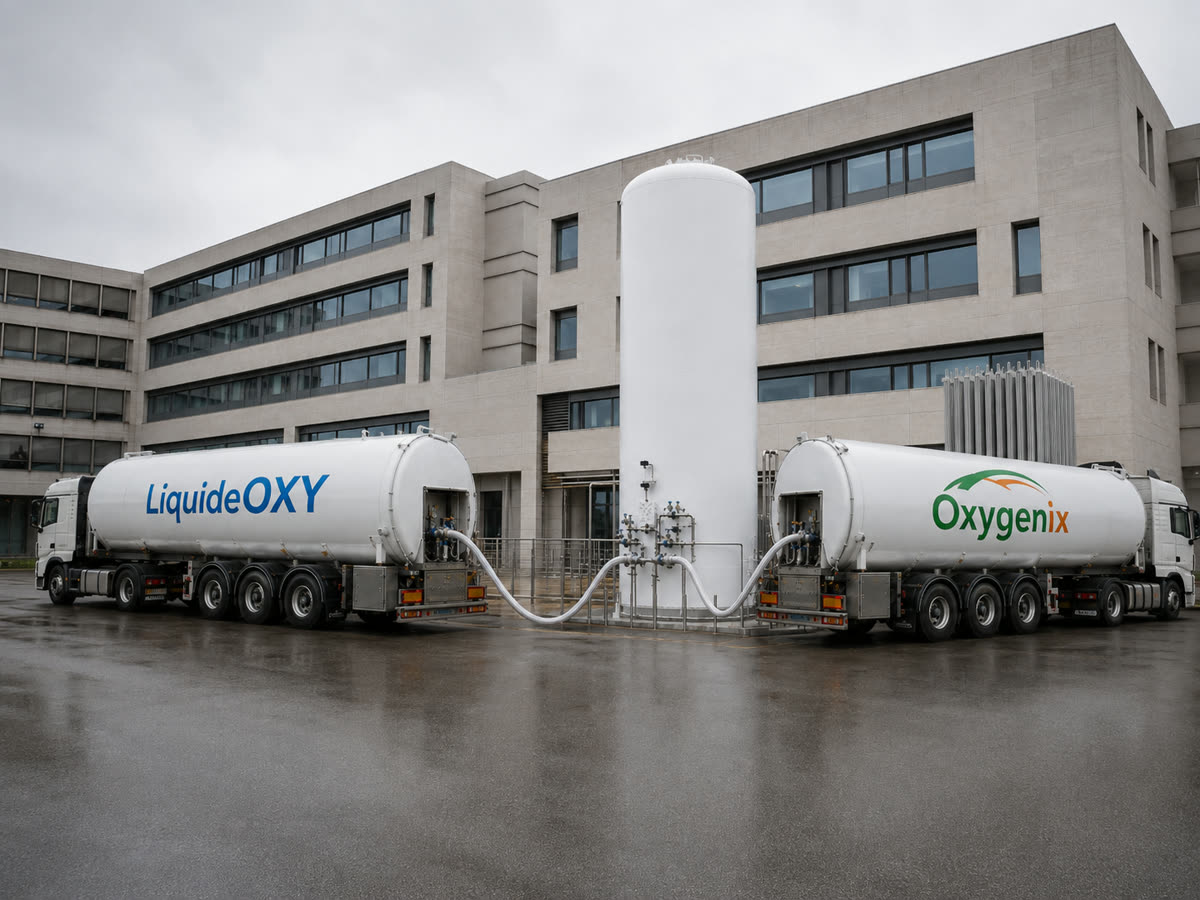
Medical oxygen from two suppliers — what the standard says and where the risk really lies
2026-08-25 · Damian Czyczyro
In brief. Standard PN-EN ISO 7396-1:2016-07 contains no criterion on the identity or number of parties supplying medical gas — supplying one installation with medical oxygen from two marketing authorisation holders does not breach the standard. Nor is this restricted by the Act of 6 September 2001 – the Polish Pharmaceutical Law. The real risk lies elsewhere: an automatic source changeover changes the marketing authorisation holder responsible for the medicine administered to the patient, and the standard's forms provide no record of that event. The hospital pharmacy therefore keeps a register assigning each batch to the source and the supply period — just as for any other medicine. The critical conditions of the dual-supplier arrangement are that register and documented pharmaceutical supervision.
In tenders and technical studies, the claim regularly appears that supplying one medical gas installation with oxygen from two suppliers — typically liquid oxygen from one party as the primary source and cylinders from another as the secondary and reserve sources — is “contrary to the standard”. Usually without naming the clause. We checked the entire standard and the pharmaceutical legislation, point by point. The claim does not hold — but that does not mean there is no problem. There is one, just in a completely different place than the tender studies suggest.
Two legal regimes in one physical system
The starting point without which any further analysis collapses: the installation and the gas flowing through it are two different objects of regulation. The pipeline system is a class IIb medical device under rule 12 of Annex VIII of Regulation MDR (EU) 2017/745. The medical oxygen flowing through it is a medicinal product within the meaning of Art. 2(32) of the Pharmaceutical Law. The responsibility of the device manufacturer and the responsibility of the marketing authorisation holder for the medicine are separate by operation of law and cannot be merged by contract.
| Criterion | Installation (MGPS) | Medical oxygen (gas) |
|---|---|---|
| Classification | class IIb medical device (MDR, Annex VIII, rule 12) | medicinal product (Art. 2(32) of the Pharmaceutical Law) |
| Legal regime | MDR; the Medical Devices Act | Pharmaceutical Law; the Act on the Profession of Pharmacist |
| Who places it on the market | the device manufacturer (Art. 10 MDR) | the marketing authorisation holder (Art. 2(24) of the Pharmaceutical Law) |
| Who supplies it | — | a pharmaceutical wholesaler (Art. 72(1) of the Pharmaceutical Law) |
| Supervision in the hospital | the Authorised Person (AP), Annex G of the standard | the head of the hospital pharmacy |
| Supervisory authority | the President of the URPL | the State Pharmaceutical Inspectorate |
Does the standard limit the number of gas suppliers?
No. A review of the entire PN-EN ISO 7396-1:2016-07 — normative part and annexes — revealed not a single requirement concerning the identity or number of parties supplying the gas. The requirements for supply sources are purely configurational and functional: the primary source shall be permanently connected and constitute the main supply (5.2.3), the secondary source shall take over automatically (5.2.4), the reserve source shall be permanently connected (5.2.5). Annex A describes typical configurations — including a cryogenic tank plus two cylinder banks — without a word about the origin of the gas.
Two provisions settle the matter conclusively. First, clause 1.2 NOTE 4 and Annex J permit the coexistence of oxygen and oxygen 93 in one pipeline — that is, two different medicinal products, whose concentration at the terminal units can change at any moment and without warning. If the standard allows two distinct products in one network, the coexistence of two products identical to the same pharmacopoeial monograph cannot possibly be a non-conformity. Second, clause 13.3.3 requires the instructions for use to account for the involvement of several different parties in the construction, use and maintenance of the system. The standard orders multi-party operation to be handled, not eliminated.
Does the Pharmaceutical Law limit the number of marketing authorisation holders?
Also no. The Act is built the other way round: a marketing authorisation is issued separately for the product of each holder (Art. 3(1)), and responsibility attaches to the product identified by its batch number — not to exclusivity of supply. Several holders supplying the same medicine is everyday reality in the drug management of every hospital pharmacy, and no authority classifies it as a risk. Formulating a claim of “non-conformity with the standard” without citing the clause is methodologically untenable.
What really happens at an automatic source changeover?
Here the real problem begins — consistently overlooked in tender studies. The standard classifies source changeover as a normal condition, not a failure: the system shall pose no unacceptable risk in normal condition and in single fault condition (4.1), equipment maintenance is a normal condition (3.60 NOTE), and the control equipment must be serviceable without interrupting the gas supply (5.2.2.2).
In a dual-supplier arrangement, every such changeover means a change of the marketing authorisation holder responsible for the medicine administered to the patient at that moment. The change occurs repeatedly over the operating cycle, automatically, without the staff's involvement or knowledge — with pressure fluctuations, deliveries, servicing — and without any record, because the standard provides for none. It is an event of a pharmaceutical nature occurring in a technical regime that does not register it.
The batch register — obvious to a pharmacist
Pharmaceutical legislation bases the supervision of a medicine on full batch traceability. The wholesaler records every transaction with the batch number, and in such a way that it can be established where the product was at a given time (Art. 78(1)(7) and (8) of the Pharmaceutical Law). In the hospital, supervision of drug management, receipt, dispensing and recall procedures belongs to the pharmacist's professional tasks (Art. 86(2) of the Pharmaceutical Law in conjunction with Art. 4(4)(5), (7), (9) and (10) of the Act on the Profession of Pharmacist), and executing a decision to suspend or recall a batch — to the head of the hospital pharmacy (Art. 93(2) in conjunction with Art. 88(5)(7)). The standard itself is consistent with this: Annex G clause G.2.2 states that medical gases are subject to the same quality control and ordering procedures as any other medicine, and provides for a quality controller function (QC, G.3.1(e) and K.4) — a role usually assigned to the chief pharmacist.
The standard's forms, however, contain no such record: Annex D covers gas identity testing at acceptance and after intervention (D.20, D.21.1), and the Operational Management Documentation records concern equipment operation, testing, maintenance and staff qualifications. For a pharmacist the conclusion is obvious: since oxygen from the network is a medicine like any other, the batch register is kept just as for any other medicine — assigning each batch to the supply source and to the date, the time of switching in and the period of supplying the network. The place for this register is the hospital pharmacy's procedure and the Operational Management Documentation.
The recommendation applies regardless of the number of suppliers, but with two it carries double weight: the chronology of exposure must then be reconstructed from the changeover sequence between the sources of different holders and matched against the records of two independent wholesalers — and once past the manifold, the products lose their physical separateness, the only remaining trace being precisely the pharmacy's record. More about the operational documentation itself in our article on the Operational Management Documentation.
Who guards quality on the supplier's side?
A supplementary finding, important for how the supervisory burden is distributed. The Responsible Person at a pharmaceutical wholesaler is, as a rule, a pharmacist with two years' experience (Art. 84(1) of the Pharmaceutical Law) — but at a wholesaler trading exclusively in medical gases, a secondary-school certificate and health-and-safety training suffice (Art. 84(3)). In the hospital's entire oxygen supply chain, the only statutorily guaranteed pharmaceutical link is therefore the hospital pharmacy. The burden of substantively assessing deliveries — with two suppliers: two independent chains — rests entirely on its head and cannot be transferred to the suppliers. On why hospital oxygen belongs to the pharmacy rather than the technical department, see the article in a hospital, oxygen is a medicinal product.
When is supply from two suppliers safe — six conditions
The technical hazards raised in tenders — backflow, cross-contamination, gas with wrong parameters — are catalogued explicitly in Table F.1 of Annex F, and the control measure is design and operation (the design itself, tests D.8 and D.13, the Operational Management Documentation), not limiting the number of suppliers. If backflow is physically possible in an installation, that is a non-conformity of the device with clauses 4.1 and 5 of the standard — regardless of who supplies the gas. The dual-supplier arrangement is permissible when all of the following are met:
- W1. Both products meet the requirements of the same pharmacopoeial monograph (Oxygenium), including the limits for water and impurities.
- W2. A register is kept assigning each batch to a specific supply source and to the date, the time of switching in and the period of supplying the network.
- W3. The head of the hospital pharmacy, or a pharmacist designated by them, acts as quality controller (QC) and takes a documented decision to release the batch — verifying the batch documentation, without repeating the pharmacopoeial analysis, which belongs to the manufacturer's Qualified Person.
- W4. The effectiveness of the backflow protection has been confirmed by testing (forms D.8 and D.13).
- W5. The scopes of service responsibility — especially for the control equipment and the changeover automation — are unambiguously delimited.
- W6. The whole is incorporated into the Operational Management Documentation and the pharmacy's procedure, after a documented risk assessment in accordance with ISO 14971.
Conditions W2 and W3 are critical: without them, the statutory duty to recall a batch is practically unworkable.
Frequently asked questions
Does supplying an installation with oxygen from two suppliers breach PN-EN ISO 7396-1?
No. The standard contains no criterion on the identity or number of parties supplying the gas; it even permits the coexistence of oxygen and oxygen 93 — two different medicinal products — in one pipeline, and requires multi-party operation to be accounted for (13.3.3). A claim of non-conformity made without citing a clause of the standard is untenable.
Can oxygen from two holders mix in the pipeline?
Once past the manifold, the products lose their physical separateness — but both must meet the same pharmacopoeial monograph, so the patient receives a medicine with the same parameters. The standard even permits products of different oxygen concentrations in one network (1.2 NOTE 4, Annex J). The problem is not chemistry but documentation: which holder was responsible for the gas at a given moment.
Who is responsible for recalling a batch of oxygen administered from the network?
The head of the hospital pharmacy — they must ensure the execution of a suspension or recall decision (Art. 93(2) in conjunction with Art. 88(5)(7) of the Pharmaceutical Law). The workability of this duty depends on a register assigning the batch to the source and the supply period — the hospital pharmacy keeps it in its procedure just as for any other medicine.
Basis
- PN-EN ISO 7396-1:2016-07 — clauses 1.2 NOTE 4, 3.60, 4.1, 5.2.2.2–5.2.5, 13.3.3; Annexes A, D (D.8, D.13, D.20, D.21.1), F (Table F.1), G (G.2.2, G.3.1(e)), J, K
- Regulation MDR (EU) 2017/745 — Articles 10, 16 and 22; Annex VIII, rule 12
- The Act of 6 September 2001 – the Polish Pharmaceutical Law — Art. 2(21c), (24) and (32), Art. 3(1), Art. 72(1), Art. 78(1)(7) and (8), Art. 84, Art. 86, Art. 88(5), Art. 93, Art. 121(5)
- The Act of 10 December 2020 on the Profession of Pharmacist — Art. 4(4)(5), (7), (9) and (10)
- Act of 7 April 2022 on medical devices
- The Regulation on Good Distribution Practice requirements and Good Manufacturing Practice (Annex 6: medical gases)
- PN-EN ISO 14971 — medical device risk management; European / Polish Pharmacopoeia, Oxygenium monograph
See also: medical gas installations for hospitals, medical gas installation projects in hospitals.
Prepared by: Damian Czyczyro — Medpipe Sp. z o.o.