

A medical gas installation is not a single device — what a pipeline system certificate does not cover
2026-08-24 · Łukasz Konieczny
In brief. A certificate for a “medical gas pipeline system” does not cover the supply sources — the installation is an assembly of devices within the meaning of Article 22 of Regulation MDR (EU) 2017/745, not a single device. Sources generating gas on site require their own CE marking (Annex K to the standard PN-EN ISO 7396-1:2016-07). At acceptance, request a declaration of conformity for each device and the assembly document.
The same picture repeats itself at acceptance inspections. The contractor puts a notified body certificate issued for a “medical gas and vacuum pipeline system” on the table and treats it as proof of conformity for everything it has supplied — including the compressed air supply system, the oxygen pressure reduction station and the vacuum plant. Someone asks for the EU declaration of conformity for the supply system itself. Silence falls, and then comes the answer: the supply system is part of the system, and the system has a certificate.
I hear this often enough that I have stopped treating it as one contractor’s slip. The misconception has a logic of its own — and it can be settled with documents rather than with debate.
The standard describes a hierarchy, not synonyms
PN-EN ISO 7396-1:2016-07 defines the medical gas pipeline system (3.36) as a complete assembly consisting of a supply system, a monitoring and alarm system and a pipeline distribution system with terminal units. It defines separately the supply system (3.64), the pipeline distribution system (3.48) and the terminal unit (3.66). Particular forms of supply system have entries of their own: air compressor system (3.1), vacuum supply system (3.68), cryogenic liquid system (3.9), oxygen concentrator (3.44).
This is a hierarchical structure. The higher-level name does not thereby become a synonym for any of the elements it covers.
Each of these elements also has its own product standard:
- supply systems for compressed gases and vacuum — ISO 7396-1;
- supply systems for anaesthetic gas scavenging systems — ISO 7396-2;
- supply systems for synthetic air — ISO 7396-3;
- medical supply units together with valve box enclosures — ISO 11197;
- copper tubes — EN 13348;
- terminal units — ISO 9170-1 and ISO 9170-2;
- pressure regulators — ISO 10524-2;
- hose assemblies — ISO 5359.
The installation is a system of devices, not a single device
A medical gas installation is a combination of devices intended to be inter-connected, each of which has its own manufacturer, its own intended purpose and its own EU declaration of conformity. This is governed by Article 22 of Regulation (EU) 2017/745: paragraph 1 provides that a natural or legal person combining devices bearing a CE marking in accordance with their intended purpose and within the limits of use specified by their manufacturers draws up a statement, and paragraph 2 sets out its content — verification of the mutual compatibility of the devices, provision of information to the user, and subjecting the combining activities to internal monitoring, verification and validation.
A CE certificate for a medical gas pipeline system does not confer a CE marking on the supply systems, the medical supply units or the terminal units. Each of these devices has its own manufacturer and its own EU declaration of conformity.
Why a certificate covering the whole installation does not exist
It follows directly from Article 22(5): the system or procedure pack itself does not bear an additional CE marking — it carries the name and address of the person combining the devices, and the statement is kept at the disposal of the competent authorities. A correctly assembled system therefore receives neither a CE marking of its own nor a certificate of its own.
The second reason is procedural. Under Article 52(4), manufacturers of class IIb devices are subject to an assessment of the technical documentation of at least one representative device per generic device group; paragraph 6 provides an analogous mechanism for categories of class IIa devices. The procedure rests on a representative device, and the installation in a particular hospital does not form a generic device group: its routes, diameters, layout of terminal units and configuration of supply systems follow from the architecture of the building.
A pipeline system certificate therefore confirms exactly one thing: that its holder is able to combine CE-marked medical devices and to make pipeline joints correctly. It is an installer’s qualification, not a manufacturer’s.
Europe settled this almost thirty years ago
The dispute is neither new nor Polish. In 1998 the co-ordination group of notified bodies adopted the common position NB-MED S/06/98 “Medical gas pipeline systems in hospitals”. The document classifies the components as separate medical devices: manifold and line pressure regulators, terminal units and medical supply units in class IIb, copper tubes and components of anaesthetic gas scavenging systems in class IIa. It also describes the scenario in which a hospital commissions an installation to its own design — in that case the complete installation is not placed on the market and CE marking of the finished installation does not apply.
Norway has confirmed this recently. Formally it is not a member of the Union, but as a European Economic Area state it applies the same Regulation 2017/745. The Norwegian Direktoratet for medisinske produkter — the counterpart of Poland’s URPL — states in its guidance for healthcare providers that an installation placed on the market as a system falls under Article 22 and under the requirements applying to those who combine devices into systems within the meaning of Article 2(11); that a system may combine CE-marked devices with other products lawfully placed on the market and does not require an additional CE marking; and that the person combining the devices gives their name and address on it and verifies the mutual compatibility of the devices. The guidance: dmp.no — Medical gas pipeline systems
https://www.dmp.no/en/medical-devices/for-healthcare-facilities/medical-gas-pipeline-systems
Two documents, almost three decades apart, the same conclusion.
A supply system is not a compressor
This is where the misconception that drives the whole dispute lies. A compressor bought from a compressor manufacturer is not a medical device — it never was one and cannot be one — and on its own it has no business supplying a hospital installation. Within a complete supply system it is, paradoxically, a component of only moderate importance: its task is to compress and to generate flow. The quality of the product is determined by what stands downstream of it.
The medical device is the complete supply system: an assembly of compressors with a control system, divided into a primary, a secondary and a reserve supply, distributed over at least two fire compartments so that a fire affecting the primary and secondary supply does not cut off the feed from the reserve. Add to that condensate separators, dryers — often refrigerant dryers at the inlet and always adsorption dryers for a −46 °C dew point, always in a duplex arrangement — filtration, a receiver placed downstream of the dryers, valves and fittings, pressure reduction and mandatory monitoring of the carbon monoxide content and the dew point with alarm indication.
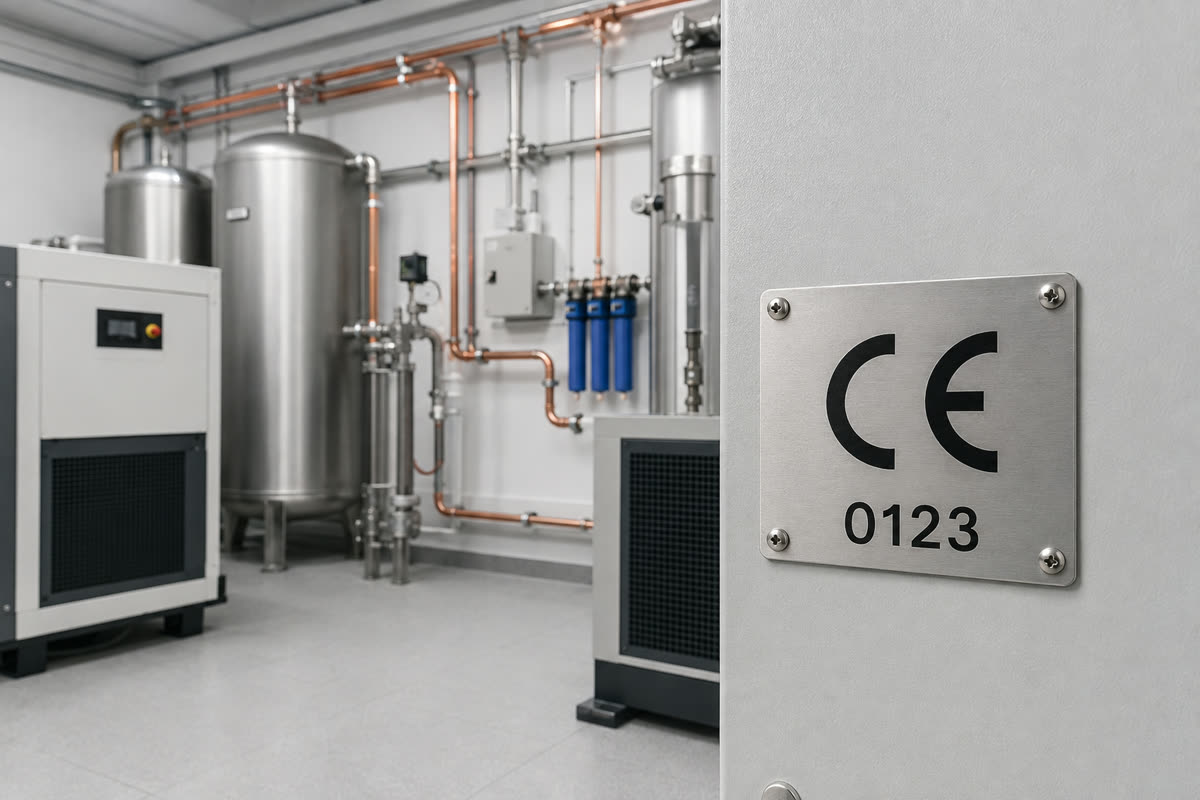
Only this complete assembly has an intended purpose, a performance characteristic, safety limits and instructions for use. Only it undergoes conformity assessment, receives a nameplate with the CE marking and the notified body number, an EU declaration of conformity and a certificate confirming that what passed the assessment was the supply system, not the pipeline system. The same applies on the vacuum side, and to the cryogenic vessel, the cylinder manifold and the concentrators: nobody assesses a single vacuum pump — what is assessed is the complete plant.
Two routes that should not lead to the same document
In tender procedures the two are sometimes treated as equivalent. The first party places supply systems on the market as separate devices. For a medical compressed air supply system in class IIa it provides a full set of documents: a notified body certificate bearing that body’s number, issued under Regulation 2017/745, an EU declaration of conformity for the medical device and a declaration for Directive 2014/68/EU, because the assembly of vessels and pressure fittings meets the definition of a pressure equipment assembly. On top of that come the essential health and safety requirements of Machinery Directive 2006/42/EC, the requirements of IEC 60601-1 and electromagnetic compatibility testing.
Behind those documents lies work that is not visible in a tender: a quality management system to ISO 13485 covering design and manufacture, control over the supply of materials, the tests required by ISO 7396-1 (automatic changeover between the primary, secondary and reserve supply, operating alarms and emergency operating alarms), calibration of pressure gauges, dew point sensors and carbon monoxide analysers, electrical safety and EMC to IEC 60601-1 and IEC 60601-1-2, and, where the supply system is controlled by software, management of that software’s life cycle to IEC 62304.
On the other side stands the installation contractor holding a pipeline system certificate. It buys off-the-shelf compressors, dryers and receivers, assembles them on site, certifies them as a system and claims that this is the same thing.
One more misconception needs defusing here. A compressor, a dryer or a receiver bought separately have declarations of conformity of their own — low voltage, pressure equipment, machinery, EMC. Those documents, however, belong to the components, not to the medical device. Collecting the declarations and instructions of the individual components and presenting them as the documentation of a medical device is the same mistake as producing a pipeline system certificate instead of a declaration for the supply system: mixing up the levels.
Responsibility for the medical device is taken by whoever appears on the device label — not the compressor or dryer manufacturer, whose equipment merely has to be operated within the conditions they specify, and whose role ends there. Neither of them, any more than the holder of a pipeline system certificate, takes responsibility for the medicinal product delivered to the patient. Someone has to take that responsibility.
The standard requires CE marking for supply systems that generate gas on site
Annex K to ISO 7396-1 deals with the production of medical gas on the premises. K.2.1 lists what may be produced on site: oxygen 93 from concentrators, medical air from compressors, medical air from a mixing system and air for driving pneumatic surgical tools. In K.2.2 the standard requires the equipment used for production to hold certificates confirming that it is fit for its intended purpose, and indicates that in the Union the appropriate approval is CE marking granted with the involvement of a notified body. The standard refers to the repealed Directive 93/42/EEC; today the obligation is read through Regulation 2017/745.
The device category is confirmed by the classification guidance MDCG 2021-24: the list of examples for rule 12 of Annex VIII names pressure regulators for medical gases, medical gas mixing devices and oxygen concentrators — all in class IIb. Rule 2 is illustrated by tubing used as a conduit in active drug delivery systems. The division is clear: the pipe conveys, the supply system produces and delivers.
Confirmation has also come from public procurement case law. In its ruling of 9 April 2026 (case no. KIO 857/26) Krajowa Izba Odwoławcza (the Polish public procurement appeals chamber) ordered the contracting authority to remove from the tender documents the requirement to produce a CE certificate for a medical gas pipeline system as a class IIb device, holding that where the subject of the contract is not a complete pipeline system but an air compressor system and a vacuum supply system together with their distribution, the contracting authority should align the scope of certification with the nature of what is actually being provided.
Manufacture in the factory, installation on site
The fourth edition of ISO 7396-1 has reached FDIS, the last stage before publication — the record of the standard: ISO/FDIS 7396-1 https://www.iso.org/standard/87169.html. One of its effects is an explicitly drawn distinction that the current text lacks.
The supply system is manufactured at the manufacturer’s works: the design of the arrangement, subject to conformity assessment at the design stage as well, the selection of the component equipment, assembly of the unit, testing and documentation. What takes place on site is the installation of that supply system: setting it in place, adjusting the lengths of the pipe runs between the receiver, the compressor, the dryer and the filter, connecting the utilities, commissioning and acceptance testing.
This closes off the most common counter-argument: that because the supply system is finally put together on the building site, it is not a series-produced device and cannot be assessed. Adjusting a length of pipe between the receiver and the compressor changes neither the intended purpose of the supply system, nor its performance, nor the safety limits declared by the manufacturer. What is not series-produced is the pipeline route through the building, not the machinery set in the plant room.
How to check whether a contractor can deliver what it claims
Verification has ceased to be a matter of trust. The public database EUDAMED lets you check this for yourself. The actors module shows the SRN registration number and the role: manufacturer, authorised representative, importer. If a company presenting itself as a manufacturer of supply systems is not listed there as a manufacturer, that is the first signal to ask a question. The devices and UDI module shows what it has actually registered, and the certificates module — the scope of the documents issued by notified bodies.
The most important thing, however, is what has to be demanded from the contractor. Without four pieces of information it is impossible to establish what a given company may manufacture:
- the type of device;
- the intended purpose;
- the class;
- Basic UDI-DI.
The intended purpose matters here as much as the trade name, because it is what determines whether the entry covers gas supply systems, the distribution system or medical supply units. The declaration of conformity, in turn, must identify a specific device — with a serial number and a name matching its intended purpose.
The conclusion for the acceptance committee and the procurement department is simple: the name “medical gas and vacuum pipeline system” is not the same thing as a medical compressed air supply system or an anaesthesia pendant — even though both of those devices fall within the definition of such a system. A coincidence of names is not proof of scope.
Frequently asked questions
Is a pipeline system certificate worthless?
No. It confirms installer competence: the ability to combine CE-marked devices and to make pipeline joints correctly. What it does not confirm is that its holder is a manufacturer of supply systems, panels or terminal units.
May a contracting authority require a single certificate for the whole installation?
No such document exists — Article 22(5) of Regulation 2017/745 expressly rules out an additional CE marking on a system. Requiring one in a tender procedure leads to the situation described in ruling KIO 857/26.
What should be demanded in a tender procedure instead?
EU declarations of conformity and certificates for each device separately — supply systems, medical supply units, terminal units — together with the statement of the person combining the devices under Article 22(2). The scope of certification should match what is actually the subject of the contract.
Is a CE-marked compressor enough to serve as a supply system?
No. The CE marking on a compressor relates to the machinery, low voltage and electromagnetic compatibility directives, not to the Medical Device Regulation. The medical device is the complete supply system together with drying, filtration, pressure reduction and gas quality monitoring.
Basis
- PN-EN ISO 7396-1:2016-07 — definitions 3.1, 3.9, 3.36, 3.44, 3.48, 3.64, 3.66, 3.68; Annex K (gas production on the premises)
- ISO/FDIS 7396-1 — fourth edition at the approval stage
https://www.iso.org/standard/87169.html - Regulation (EU) 2017/745 (MDR) — Article 2(11), Article 22(1), (2) and (5), Article 52(4) and (6), rule 12 of Annex VIII
https://eur-lex.europa.eu/eli/reg/2017/745/oj - NB-MED S/06/98 — “Medical gas pipeline systems in hospitals”, position of the notified bodies from 1998
- Direktoratet for medisinske produkter (Norway) — guidance for healthcare providers
https://www.dmp.no/en/medical-devices/for-healthcare-facilities/medical-gas-pipeline-systems - MDCG 2021-24 — classification guidance, examples for rules 2 and 12
https://health.ec.europa.eu/medical-devices-sector/new-regulations/guidance-mdcg-endorsed-documents-and-other-guidance_en - Ruling of the Krajowa Izba Odwoławcza of 9 April 2026, case no. KIO 857/26 — KIO case law
https://orzeczenia.uzp.gov.pl/ - ISO 7396-2, ISO 7396-3, ISO 11197, EN 13348, ISO 9170-1, ISO 9170-2, ISO 10524-2, ISO 5359 — product standards for the components
- ISO 13485, ISO 14971, IEC 60601-1, IEC 60601-1-2, IEC 62304 — quality system, risk, safety, EMC, software
- EUDAMED — the public database of actors, devices and certificates
https://ec.europa.eu/tools/eudamed
Medical gas and vacuum supply systems are separate medical devices. The declaration of conformity and the notified body certificate are issued for the supply system, not for the pipeline system. Medpipe supplies components and sub-assemblies for them — air compressors, dryers and control systems — and is a distributor and authorised service provider for air supply systems, vacuum supply systems and oxygen concentrators covered by conformity assessment. We also prepare technical opinions and verify contractors’ documentation for acceptance committees and procurement departments.
A table of the devices in an installation with their standards, CE marking and typical class, together with a discussion of hospital pharmacy supervision of gas produced on site, can be found in the article: medical devices in a medical gas installation.
See also: medical gas installations for hospitals, medical gas installation projects in hospitals.
Prepared by: Łukasz Konieczny — Medpipe Sp. z o.o.; member of Technical Committee No 284 for medical equipment and apparatus at the Polish Committee for Standardization (PKN), repeatedly appointed by the courts as an expert witness in medical equipment and devices; edited by: the Medpipe technical team (Małgorzata Dopierała, Damian Czyczyro, Przemysław Kostera). An extended version of this text appeared in the quarterly “Wyroby Medyczne” 3/2026 (39).